
Basement Mold Removal in Durham, NC
Damp block walls, a musty finished basement or spotting on the framing behind paneling. Describe it once and independent mold companies serving Durham, NC and the Triangle can reply with free quotes. Durham NC Mold Remediation is a free quote service, not a mold company.
Get a Free Quote Call (919) 386-4072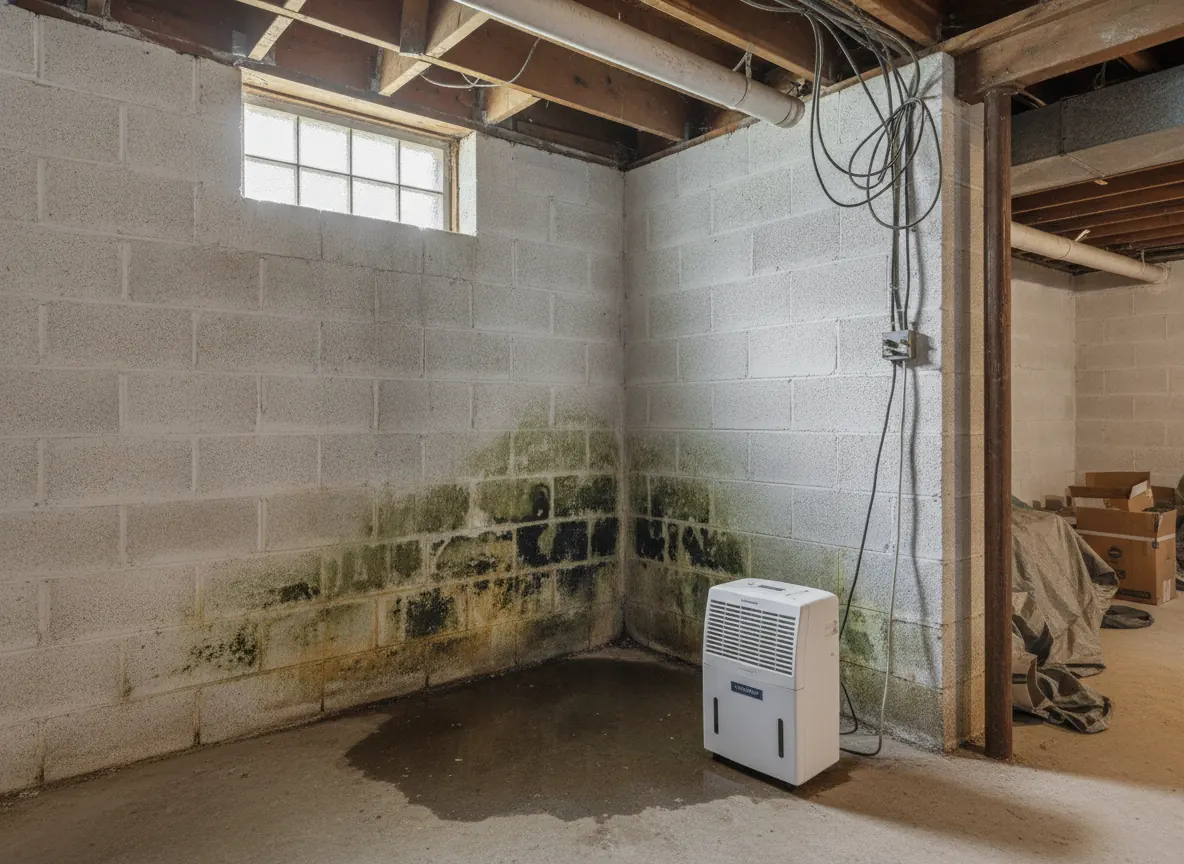
Signs of mold in basement walls and floors
- A musty smell that gets stronger in summer or after heavy rain
- Dark spotting on the bottom of drywall, paneling or baseboards along outside walls
- Fuzzy or spotty growth on wood framing, sill plates or the underside of stairs
- Damp carpet or carpet pad, or a rug that smells after it dries
- Damp patches or white mineral crust on block walls
White crust on block is often efflorescence rather than mold, but both mean water is moving through the wall. Not sure which you have? An independent mold inspection can sort it out before anyone quotes removal.
Why basements in Durham, NC get damp
Basements are less common than slabs and crawl spaces in new Triangle construction. NAHB data show 85.7% of 2024 single-family starts in the South Atlantic region were on slabs. Where basements exist, they get wet in a few predictable ways.
Humid summer air meets cool walls
RDU averages summer dew points in the mid-to-upper 60s, with July the stickiest month at about 68.7°F (NOAA 1991–2020, computed from hourly normals). Cooler below-grade walls collect that moisture. NCDHHS guidance says that if indoor relative humidity stays above 70 percent for extended periods, mold will almost certainly grow. EPA suggests keeping it below 60 percent, ideally 30 to 50.
Rain, grading and groundwater
RDU averages about 46 inches of rain a year, with July and September the wettest months. Gutters that dump next to the foundation, soil that slopes toward the house and clogged footing drains all push water against basement walls. Older Durham neighborhoods such as Trinity Park, Forest Hills and Watts-Hillandale have many homes built before 1960, when waterproofing was simpler.
Leaks and floods
After a storm or plumbing leak, see mold after water damage for the drying window. If your home has a crawl space section next to the basement, the crawl space mold page covers that side.
What basement mold work typically involves
Every job is different, and a written scope should set the steps. A typical sequence:
Find the water
Moisture readings on walls, slab and framing show whether the source is condensation, a leak or groundwater.
Contain the area
Plastic sheeting and negative air keep dust and spores from spreading up the stairs or into ductwork.
Remove what can't be cleaned
Moldy drywall, insulation, carpet and pad usually come out. Framing and block are cleaned and HEPA vacuumed.
Dry and control humidity
Drying equipment runs until readings are back to normal. A dehumidifier, drainage or waterproofing work may follow.
Check the result
Clearance testing by an independent company, not the remediator, confirms the area is ready to rebuild.
Waterproofing, French drains and sump pumps are moisture control, not mold removal. Ask each company to quote them separately so you can compare like with like.
What basement mold removal costs
No published source gives a basement-only figure, so these national ranges are the closest guide. For the full table and a calculator, see the mold remediation cost guide for Durham.
| Item | Typical range | Source |
|---|---|---|
| Mold remediation, overall | $1,500–$9,000 (avg ≈ $3,500) · $1,200–$3,750 (avg ≈ $2,300) | Fixr, Aug 2025 · This Old House, Mar 2026 |
| Per square foot | $10–$30 · $10–$25 (avg ≈ $18) | Fixr · This Old House |
| Mold inspection / testing | $450–$800 (avg ≈ $500); inspection only $300–$600 | Fixr, Jan 2025 |
Insurance depends on the cause. North Carolina homeowners forms include a mold and fungus endorsement with limits, and flood or rising water is excluded. Check your declarations page.
NC rules box: basement jobs
North Carolina does not license mold inspection or remediation companies, so checking credentials is up to you. What you can check: IICRC certification (public locator at iicrc.org), ACAC credentials (acac.org/find), a certificate of insurance, and an NC general contractor license from the NC Licensing Board for General Contractors for rebuild work of $40,000 or more (G.S. 87-1).
State health guidance from NCDHHS (2005) advises: "Do not hire a consultant who also provides remediation services." That is best practice, not a legal requirement in North Carolina.
Older homes may have asbestos in materials that get torn out. NCDHHS says an accredited asbestos professional must inspect before demolition or renovation, and a state permit applies to abatement above 35 cubic feet, 160 square feet or 260 linear feet. Ask your contractor whether an asbestos inspection is needed, or call the NC Health Hazards Control Unit at 919-707-5950.
Permits: G.S. 160D-1110(c) says single-family work of $40,000 or less needs no building permit unless it involves structural, plumbing, HVAC or electrical work. For Durham-specific rules, check with Durham City-County Inspections.
Questions to ask each company
- Which IICRC or ACAC certifications does the company hold, and can I look them up?
- Can I see a current certificate of insurance?
- Will I get a written protocol and scope of work before anything starts?
- Who does clearance testing afterward? Is it an independent company with no stake in the job?
- Does my home's age call for an asbestos check before tear-out?
- What caused the moisture, and who fixes it?
- What are your written warranty terms, and what voids them?
- Is waterproofing or drainage part of your quote, or a separate company's job?
Quotes are available across Durham and nearby towns, including Chapel Hill and Carrboro, Hillsborough and Raleigh. See every town on the service areas page.
Get basement mold quotes in Durham
Say whether the basement is finished, roughly how much wall or floor is affected, and whether there was a leak, flood or sump failure. Photos can come later.
Durham NC Mold Remediation is a free quote service, not a mold company. Companies that receive requests may pay Durham NC Mold Remediation for them, they are independent of this site, and companies reply on their own schedules. No obligation, and you choose who to hire, if anyone. Prefer to talk? Call (919) 386-4072
Basement mold questions
Why does my Durham basement smell musty when I can't see mold?
A musty smell usually means damp materials somewhere: the back of paneling or drywall on an outside wall, carpet pad over a cool slab, or stored boxes against block. Summer is the usual season, when RDU dew points average in the upper 60s (NOAA 1991–2020) and that air meets cool basement surfaces. A moisture meter check behind finishes often finds the source before anyone opens a wall.
Is white powder on my basement wall mold?
Often it is efflorescence, the mineral salt that water leaves behind as it moves through block or concrete. It is crystalline, dissolves in water and does not grow on wood or paper. Mold is fuzzy or spotty and grows on organic material such as framing, drywall paper, carpet or boxes. Both point to moisture, so either one is worth a closer look.
Can I clean basement mold myself?
For small areas on hard surfaces, EPA has published homeowner guidance, and fixing the water comes first. Larger areas, mold inside finished walls, or growth after a flood are where a professional assessment and a written scope help. If the basement has older floor tile, pipe wrap or other suspect materials, ask about an asbestos check before anything is torn out.
Do I need a permit to rebuild a basement after mold removal?
Under G.S. 160D-1110(c), like-for-like repair in a single-family home costing $40,000 or less usually needs no building permit unless it involves load-bearing structure, a plumbing design change, or HVAC or electrical work. A new sump circuit or relocated wiring can change that. For Durham-specific rules, check with Durham City-County Inspections.
How much does basement mold remediation cost?
There is no basement-specific row in the published sources used here. National estimates put remediation at $10–$30 per square foot (Fixr, Aug 2025) or $10–$25 (This Old House, Mar 2026), with typical jobs between $1,200 and $9,000. Waterproofing, drainage and rebuild work are often quoted separately. Your quotes come from independent companies, not this site.
Found mold or a musty smell? Get free quotes.
Describe it once and independent mold companies serving Durham and the Triangle can reply with no-obligation quotes.