
Crawl Space Mold Removal in Durham, NC
White fuzz on the joists, a musty smell in the hall, a damp vapor barrier? Describe it once, and independent mold and crawl space companies serving Durham, North Carolina can reply with free quotes. Durham NC Mold Remediation is a free quote service, not a mold company.
Get a Free Quote Call (919) 386-4072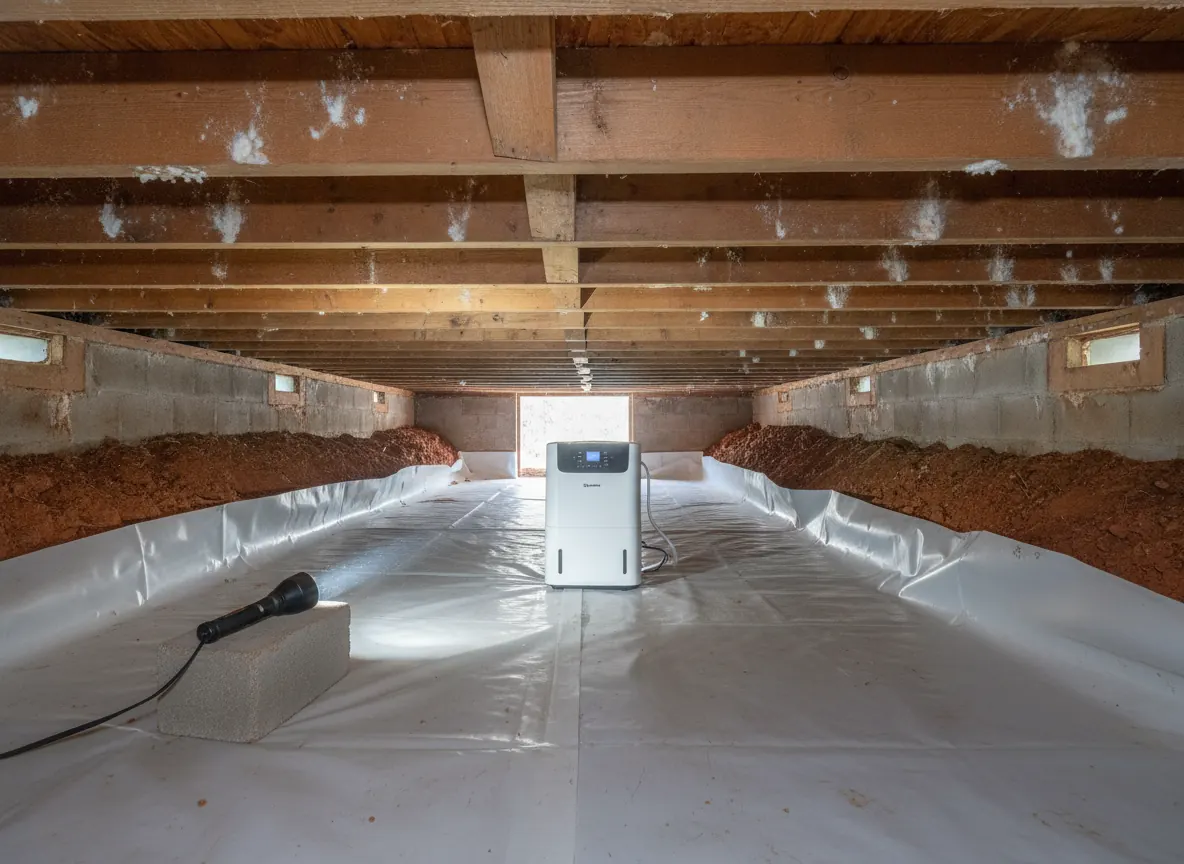
Signs of mold in a crawl space
- White, gray or dark fuzzy growth on joists, beams or subfloor
- A musty smell in the house, often worse on humid summer days
- Wet or torn plastic over the soil, standing water or wet red clay after rain
- Sweating ducts, or insulation sagging from between the joists
Not every white deposit is mold: crystal-like crust on block walls and piers can be mineral salts. Read white mold in your crawl space for the difference.
Why Triangle crawl spaces grow mold
The short answer is summer air. Raleigh-Durham averages about 46 inches of rain a year, with July and September the wettest months, and mean summer dew points in the mid-to-upper 60s (NOAA 1991–2020 normals, RDU). Humid air that moves through foundation vents meets cooler soil, wood and ductwork, and wood that stays damp grows mold.
North Carolina research measured this directly. In a field study in Princeville, NC, in eastern North Carolina, Advanced Energy in Raleigh and the NC State Solar Center compared vented and sealed crawl spaces for the U.S. Department of Energy (2005). The researchers reported that "for the summer seasons, air in the closed crawl spaces was generally below 60% relative humidity and air in the wall vented crawl spaces was often above 80 % relative humidity." They added that the vented crawl spaces "appear to be more vulnerable to fungal colonization."
State health guidance agrees: if relative humidity stays above 70 percent for long periods, "mold will almost certainly grow" (NCDHHS, 2005). Other common causes:
- Gutters and grading that send roof water toward the foundation
- Plumbing leaks under the floor that nobody sees for months
- Ducts and an air handler in the crawl space, where cold supply ducts can sweat in summer
- A missing or torn vapor barrier, or one that doesn't cover the whole floor
What crawl space mold remediation typically involves
Inspect and measure
Moisture readings on the wood, and a look at the soil cover, drainage, ducts and plumbing.
Write the scope
A written scope lists the areas, what comes out, the cleaning method and the moisture fix.
Remove and clean
Wet insulation and debris are bagged. Joists and subfloor are cleaned by HEPA vacuuming, scrubbing, sanding or blasting.
Fix the moisture
Drainage, leaks and duct sweating are addressed and the soil is covered.
Check the result
As best practice, an independent inspector confirms the wood is clean and drying.
If a company sprays a coating on the wood, ask what it is. It should not replace cleaning.
Vapor barriers and encapsulation: moisture control, not remediation
A vapor barrier is plastic over the soil. Encapsulation, or a closed crawl space, goes further: a heavier liner over the floor and up the walls, sealed seams, closed vents and a dehumidifier or conditioned air. Advanced Energy's follow-up specification for builders called for 100% floor coverage with a "minimum 8 mil thick, fiberglass-reinforced polyethylene vapor retarder" (2008).
Encapsulation can keep a crawl space dry, but it does not remove mold that is already there. A liner sealed under moldy joists only hides the problem.
| Crawl space mold remediation | Encapsulation | |
|---|---|---|
| Purpose | Remove existing growth and wet debris | Keep the crawl space dry so growth doesn't return |
| Typical work | Cleaning joists and subfloor, bagging wet insulation | Liner over the floor and walls, sealed vents, dehumidifier |
| Who does it | Mold remediation companies | Often crawl space or waterproofing companies; some do both |
| Published range | $500–$2,000 (Fixr · This Old House) | About $5,500 average; $1,500–$15,000 (This Old House, Mar 2026) |
If growth is light and the cause simple, cleaning plus a repaired vapor barrier may be enough. If the crawl space stays humid every summer, encapsulation is a common next step. Get both quoted as separate line items. Read is encapsulation a mold fix for more.
Crawl spaces in Durham and Triangle homes
There is no count of how many Triangle homes sit on crawl spaces. Nationally, crawl spaces were 9.2% of 2024 single-family starts, and 85.7% of South Atlantic starts were on slabs (NAHB). Older homes are a different stock. About 29.7% of City of Durham homes were built before 1980 (ACS 2020–2024 5-year estimates), and neighborhoods like Trinity Park, Old West Durham, Lakewood and the mill houses near downtown date from the early 1900s.
In an older house, crawl space work can disturb old pipe insulation or duct wrap, so ask about an asbestos check first.
Buying a home? North Carolina home inspectors must enter underfloor crawl spaces and report signs of abnormal water penetration or condensation, but mold itself is outside their standard (11 NCAC 08 .1105). A wet crawl space note in a home inspection report is a good reason to book a mold inspection.
Companies quote crawl space work across Durham and in Chapel Hill and Carrboro, Hillsborough, Cary, Raleigh and Wake Forest.
What crawl space mold work costs
Published national ranges. A dehumidifier with wiring typically costs $800–$2,000 to install (This Old House, Mar 2026).
| Item | Typical range | Source |
|---|---|---|
| Crawl space mold remediation | $500–$2,000 | Fixr · This Old House |
| Crawl space encapsulation | about $5,500 average; $1,500–$15,000; $3–$7 per sq ft | This Old House, Mar 2026 |
| Mold inspection / testing | $450–$800 (avg ≈ $500); inspection only $300–$600 | Fixr, Jan 2025 |
| Per square foot | $10–$30 · $10–$25 (avg ≈ $18) | Fixr · This Old House |
Run your numbers in the calculator on the Durham mold remediation cost guide, which lets you add encapsulation as a separate moisture-control line.
North Carolina mold rules in brief
No state mold license: North Carolina does not license mold inspection or remediation companies, so checking credentials is up to you. The state's contractor, home inspector and insurance statutes contain no mold license. Check IICRC and ACAC certifications, insurance, and an NC general contractor license for rebuild work of $40,000 or more (G.S. 87-1).
Separate assessor, as best practice: state law doesn't require it, but North Carolina health guidance advises: "Do not hire a consultant who also provides remediation services" (NCDHHS, 2005).
Asbestos: older homes may need an accredited asbestos inspection before tear-out, and a state permit applies above 35 cubic feet, 160 square feet or 260 linear feet. Call the NC Health Hazards Control Unit at 919-707-5950.
Permits: single-family work of $40,000 or less needs no building permit unless it involves structural, plumbing, HVAC or electrical work (G.S. 160D-1110(c)). For Durham-specific rules, check with Durham City-County Inspections.
Questions to ask each company
- Which IICRC or ACAC certifications do you and my crew hold? (Check the IICRC Global Locator or acac.org/find.)
- Can I see a current certificate of insurance?
- Will I get a written protocol and scope before work starts?
- Who does clearance testing? An independent tester who is not paid by the remediation company is best practice.
- In an older home, does anything need an asbestos check before tear-out?
- What caused the moisture, who fixes it, and is that in the price?
- What do the written warranty terms cover, and for how long?
For crawl space jobs, also ask whether the price includes the vapor barrier or encapsulation, or only cleaning. See also HVAC and duct mold and basement mold.
Get crawl space mold quotes in Durham
Say what you see under the house, how big the crawl space is and whether there is standing water. Independent companies serving Durham, NC and the Triangle can reply with quotes.
Durham NC Mold Remediation is a free quote service, not a mold company. The independent companies that receive requests may pay to receive them, and companies reply on their own schedules. There is no obligation, and you choose whether to hire anyone. Prefer to talk? Call (919) 386-4072
Crawl space mold questions
Is white mold in a crawl space a problem?
White, fuzzy growth on joists is common in damp crawl spaces, and color doesn't decide the fix. The CDC says no matter what type of mold is present, you need to remove it. White crystal crust on block walls may be mineral salts instead, so ask the inspector which you have.
Does crawl space encapsulation get rid of mold?
No. Encapsulation is moisture control: a sealed vapor barrier over the soil, closed vents and usually a dehumidifier. It helps keep growth from returning, but existing mold on joists should be cleaned first. Ask for remediation and encapsulation as separate line items so you can compare quotes.
How much does crawl space mold remediation cost?
Published national estimates put crawl space mold remediation at $500 to $2,000 (Fixr; This Old House). Encapsulation is a separate cost, about $5,500 on average with a range of $1,500 to $15,000 (This Old House, Mar 2026). Size, access, wood damage and the moisture fix all move the price.
Can mold in a crawl space get into the house?
Air can move up from a crawl space into the house through gaps around pipes, wires and ducts, which is why a musty crawl space can mean a musty house. Ducts under the floor deserve a look too. Fixing the moisture and sealing obvious gaps both help.
Does homeowners insurance cover crawl space mold?
It depends on the cause and your policy. North Carolina homeowners forms carry a mold and fungus endorsement with limits, and the 2002 change removed seepage and leakage as a covered peril. Slow humidity problems are often treated as maintenance. Check your declarations page or call NCDOI at 855-408-1212.
Found mold or a musty smell? Get free quotes.
Describe it once and independent mold companies serving Durham and the Triangle can reply with no-obligation quotes.