
Is Encapsulation a Mold Fix? Crawl Spaces in Durham's Red Clay
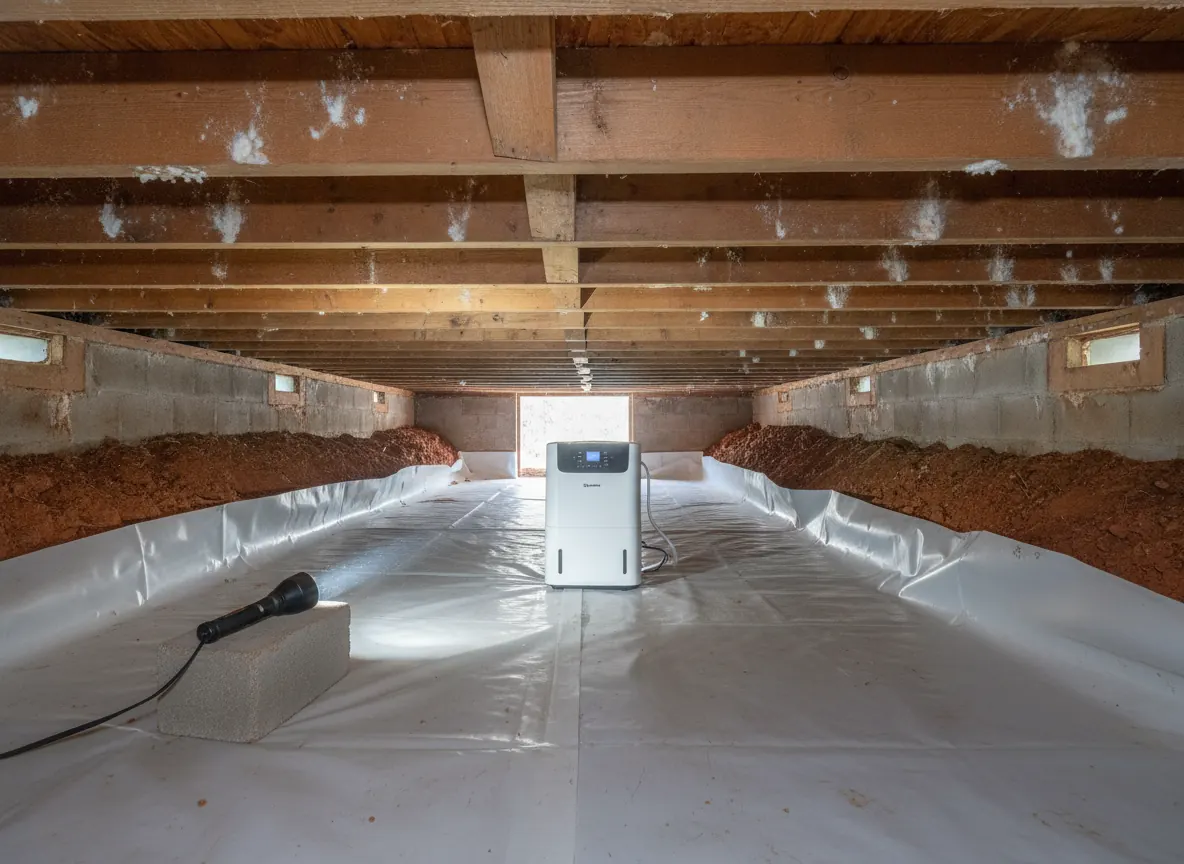
You find mold under the house, call around, and someone suggests encapsulation. It sounds like the complete answer: seal the crawl space and the problem is gone. In Durham, NC it is a common recommendation, and it can be a good one. But encapsulation is a way to control moisture. It does not remove mold that is already growing on the wood.
The short version. Encapsulation keeps a crawl space drier. It does not clean joists. The usual order is to fix bulk water, remove the existing mold, dry the wood, and then seal the space if it makes sense for the house. Sealing plastic over active growth and wet wood can hide the problem rather than solve it.
What encapsulation actually means
The word gets used loosely. Ask any company you talk to what it includes, because quotes for "encapsulation" can describe very different jobs.
| Work | What it does | What it does not do |
|---|---|---|
| Vapor barrier only | Plastic over the soil cuts moisture coming up from the ground | Stop humid outdoor air entering through vents |
| Encapsulation (sealed or closed crawl space) | Covers the floor and often the walls, seals vents, and dries the air with a dehumidifier or conditioned air | Remove mold already on the wood, or fix gutters and grading |
| Mold remediation | Removes existing growth and damaged material, then dries the area | Keep the space dry long term on its own |
Advanced Energy in Raleigh wrote a closed crawl space specification for a 2008 report with the U.S. Department of Energy. It called for 100% floor coverage with a "minimum 8 mil thick, fiberglass-reinforced polyethylene vapor retarder." That is a useful benchmark when you compare scopes.
What the North Carolina research found
The best-known study comes from Princeville, in eastern North Carolina. Researchers compared wall-vented crawl spaces with closed ones. In summer, "air in the closed crawl spaces was generally below 60% relative humidity and air in the wall vented crawl spaces was often above 80 % relative humidity." The vented crawl spaces had "periodic episodes of dew point condensation" and conditions that "supported mold growth and moisture deterioration." The closed crawl spaces also saved more than 15% on energy used for heating and cooling.
That is one study in one town, not the Triangle, and results depend on how the work is done. Still, it explains why sealing a crawl space is a serious moisture-control option here.
Why red clay and Piedmont weather matter
Durham sits in the Piedmont, and many homes here are built over red clay soil. Clay tends to drain slowly, so water from roofs, downspouts and poor grading can sit against the foundation after a heavy rain. NOAA's 1991–2020 normals for Raleigh-Durham International Airport show about 46 inches of rain a year, with July and September the wettest months. In July 2025, Tropical Storm Chantal brought a general area of 6–10 inches across Chatham, Alamance, Orange and Durham counties, according to the National Hurricane Center.
That matters for encapsulation. A liner and a dehumidifier are built to handle humidity, not a stream of water running under the house. If water pools in the crawl space after storms, drainage and gutters come first, or the liner just holds water on top of the clay.
Why sealing over mold is a mistake
Mold on joists is fed by moisture in the wood. If you seal the space while the wood is still wet and the growth is still there, a few things can happen. The mold stays on the wood, out of sight behind new plastic. Wet framing dries slowly. And a dehumidifier sized for a dry, sealed space may be working against a load it was not designed for. The better order looks like this:
Stop bulk water
Gutters, downspouts, grading, plumbing leaks and any standing water.
Remove existing mold
Clean or replace affected wood with containment and HEPA equipment.
Dry the structure
Bring wood moisture down before anything is sealed.
Seal and condition
Install the liner, seal vents and add drying, if it suits the house.
Monitor
Check humidity and look at the space after the first summer.
Questions to ask before you sign
- Is the mold cleaned before the liner goes in, and who does it?
- How thick is the liner, and does it cover the walls and piers?
- What dries the air: a dehumidifier, a supply of conditioned air, or both?
- Are there gas appliances in the crawl space, and how does the plan handle their combustion air?
- How will someone inspect the space later?
- Does the dehumidifier need a new circuit or drain line?
- What does the written warranty cover, and for how long?
Encapsulation is often done by waterproofing or crawl space companies, while mold removal is done by remediation companies. Some do both. Either way, get both parts in writing so nothing falls between them. North Carolina does not license mold inspection or remediation companies, so checking credentials is up to you. IICRC and ACAC have public locators for certifications.
Permits and contracts
Under G.S. 160D-1110(c), single-family work of $40,000 or less needs no building permit unless it involves structural, plumbing, HVAC or electrical work. A new dehumidifier circuit is electrical work. For Durham-specific rules, check with Durham City-County Inspections, or have the company confirm. If a company signs you up in your home, North Carolina's off-premises sales law (G.S. 14-401.13) generally gives buyers until midnight of the third business day to cancel on sales of $25 or more. Ask whether it applies and for the cancellation form.
What it tends to cost
This Old House (Mar 2026) puts crawl space encapsulation at about $5,500 on average, with a range of $1,500–$15,000 and roughly $3–$7 per square foot. It lists a dehumidifier with wiring at $800–$2,000 to install. Crawl space mold remediation is a separate line, about $500–$2,000 in published national estimates. These are not quotes. See the Durham mold remediation cost guide for the full table, the crawl space mold page for remediation versus encapsulation, and white mold in a crawl space if you are still working out what you found.
Frequently asked questions
Does crawl space encapsulation kill mold?
No. Encapsulation controls moisture so mold has a harder time growing. Existing growth on joists and subfloor still needs to be cleaned or removed, ideally before the space is sealed.
Do I need to remove mold before encapsulating?
That is the usual order. Fix bulk water, remove the existing mold, dry the wood, then seal. Sealing over active growth on wet wood can hide the problem instead of fixing it.
Is a vapor barrier the same as encapsulation?
Not quite. A vapor barrier is plastic over the soil. Encapsulation usually covers the floor and walls, seals the vents, and adds a way to dry the air, such as a dehumidifier.
Will encapsulation get rid of a musty smell in the house?
It can help if the smell comes from a damp crawl space, because drier air under the house means less musty air moving up. If mold is still on the wood, or the smell comes from somewhere else such as ducts, the smell may stay.
Durham NC Mold Remediation is a free quote service, not a mold company. You describe the problem once, and independent mold inspection and remediation companies serving Durham, NC and the Triangle may reply with quotes. Companies may pay to receive requests, and they reply on their own schedules. Request free quotes or call (919) 386-4072.