
White Mold in Your Crawl Space: What It Is and When to Worry
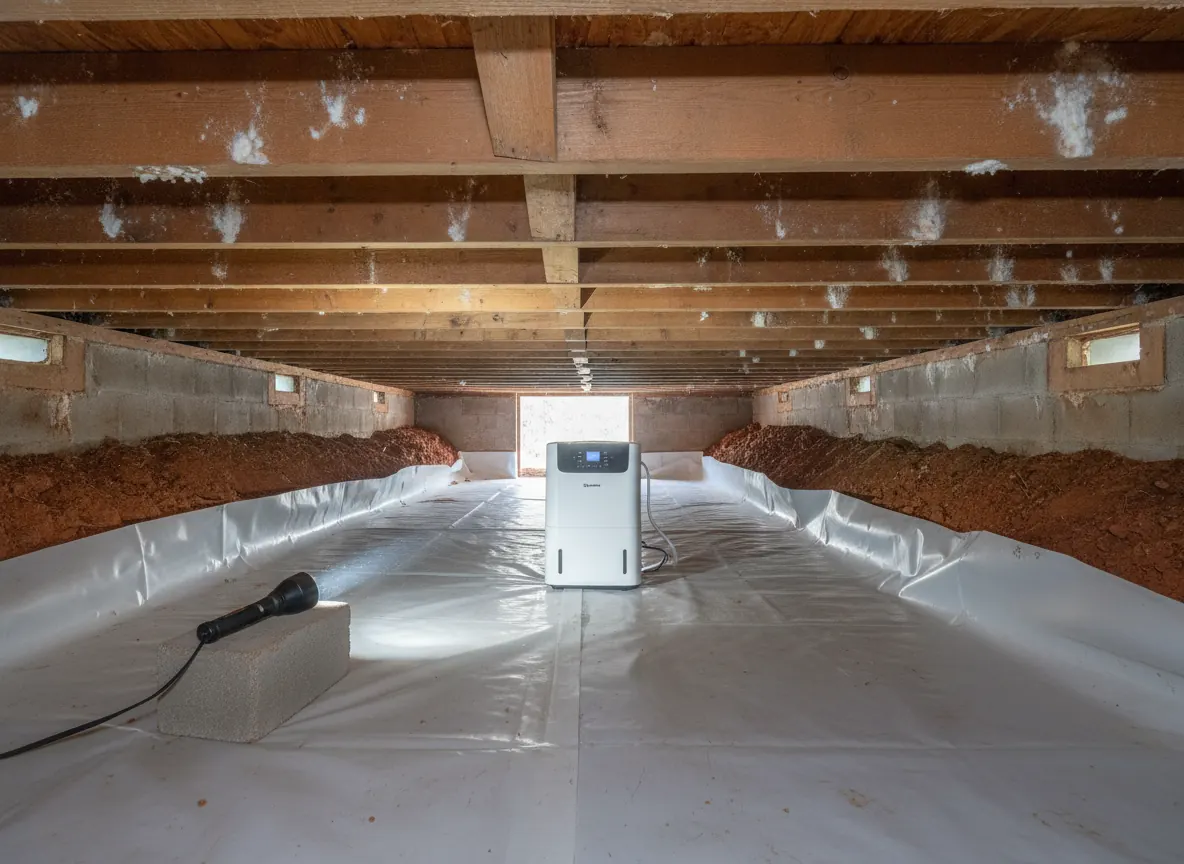
You crawl under a house in Durham, NC to check a pipe or change a filter, shine a flashlight up, and see white fuzz on the floor joists. Sometimes it looks like cotton. Sometimes it is a thin, powdery film on the wood. It is one of the most common things people find under Triangle homes, and it is usually a moisture problem first and a mold problem second.
The short version. White growth on wood in a crawl space is very often mold. There is no official "safe" amount, and the color or species matters less than the moisture feeding it. A few dry spots can be cleaned and watched. Spreading growth, soft wood, standing water or a musty smell upstairs are signs to get the space looked at and to fix the humidity before anything else.
What is the white stuff on crawl space joists?
Most of the time it is mold growing on the surface of the wood. Mold comes in many colors, and white or gray growth is common on joists, sill plates and subfloor in damp crawl spaces. Not every white deposit is mold, though. Use the table as a first look, not a diagnosis.
| What you see | Where | Often |
|---|---|---|
| Cottony or fuzzy growth that wipes or smears | Joists, subfloor, wood posts | Mold on damp wood |
| Flat white or gray film, sometimes with darker spots | Wood near the floor above, around ducts | Mold, often older growth |
| Crusty white powder that crumbles | Concrete block or brick walls and piers | Efflorescence, mineral salts left by water moving through masonry |
| Fine strands with dust caught in them | Anywhere | Cobwebs |
Efflorescence is not mold, but it still tells you water is moving through the foundation. A quick test: it dissolves and does not grow on wood. If the white material is on wood, treat it as mold until someone tells you otherwise.
Why Triangle crawl spaces grow it
The local climate does a lot of the work. NOAA's 1991–2020 normals for Raleigh-Durham International Airport show about 46 inches of rain a year, with July and September the wettest months, and about 52 days a year at 90°F or hotter. June through August mean dew points run about 65–69°F (computed from NOAA hourly normals). That is a lot of water in the air.
In a vented crawl space, that humid outdoor air drifts under the house and meets cooler wood, soil and air conditioning ducts. Relative humidity climbs, and the wood picks up moisture. A field study by Advanced Energy and the U.S. Department of Energy in Princeville, in eastern North Carolina, found that "air in the wall vented crawl spaces was often above 80 % relative humidity" in summer, while closed crawl spaces stayed "generally below 60%." The authors wrote that "wall vented crawl spaces appear to be more vulnerable to fungal colonization."
State health guidance points the same way. A 2005 NCDHHS guide says that if relative humidity "stays above 70 percent indoors for extended periods of time, mold will almost certainly grow," and that below 60 percent there is not enough water in materials for it. Other common sources under the house:
- A missing, torn or partial vapor barrier over the soil
- Gutters and downspouts that dump water against the foundation
- Slow plumbing leaks from supply lines or drains
- Sweating ductwork or a dripping AC condensate line
- Flood water from a big storm, such as Tropical Storm Chantal in July 2025
How much mold in a crawl space is acceptable?
There is no number. The NCDHHS guide says, "There are currently no uniformly accepted standards that quantify how much or what kind of airborne mold is acceptable." CDC says the same thing in plainer words: "You do not need to know the type of mold," and "No matter what type of mold is present, you need to remove it."
A more useful way to think about it is active versus not active. Light, old growth on a few joists in a crawl space that now stays dry is a low priority. Growth that keeps spreading tells you the moisture is still there.
Signs it is time to worry
- Growth across many joists or large patches of subfloor
- Wood that feels soft or lets a screwdriver sink in easily
- Standing water, wet soil or a soaked vapor barrier
- Condensation dripping from ducts or pipes
- A musty smell in the rooms above, especially in summer
- Flooding or a plumbing leak under the house in the past year
Can you clean it yourself?
For a small area on solid wood, many homeowners do, after fixing the water source. The trap is spraying a product on the joists and calling it done. If the crawl space still runs at high humidity, the growth tends to come back.
Get quotes when the growth is widespread, the wood is damaged, you cannot find the moisture source, or the crawl space is tight enough that working in it safely is hard. A home inspection will not settle the question either. Mold is outside North Carolina's home-inspection standards (11 NCAC 08 .1105), although inspectors are required to enter crawl spaces and report signs of abnormal condensation.
What crawl space remediation usually involves
Find and fix the moisture
Grading, gutters, leaks, ducts and the vapor barrier come first.
Remove the growth
HEPA vacuuming, scrubbing or abrasive cleaning of the wood, and replacing members that are too far gone.
Dry and control humidity
A full vapor barrier, sometimes a dehumidifier, and sometimes a sealed crawl space.
Check the result
A visual check and moisture readings, ideally by someone who did not do the cleanup.
Sealing the crawl space can be part of the long-term fix, but it is moisture control, not mold removal. The guide to encapsulation and mold covers the order of work, and the crawl space mold page goes deeper on Triangle crawl spaces.
Published national estimates put crawl space mold remediation at about $500–$2,000 (Fixr, Aug 2025; This Old House, Mar 2026). Those are not quotes. The Durham mold remediation cost guide has the full table and a calculator.
Checking the companies you call
North Carolina does not license mold inspection or remediation companies, so checking credentials is up to you. You can look up IICRC and ACAC certifications in their public locators and ask for an insurance certificate. NCDHHS guidance also advises, "Do not hire a consultant who also provides remediation services." That is best practice, not a legal requirement, but it keeps the person judging the problem separate from the person paid to fix it. For more on testing and assessments, see mold inspection and testing.
Frequently asked questions
Is white mold in a crawl space dangerous?
CDC says that for some people, mold can cause a stuffy nose, sore throat, coughing or wheezing, burning eyes, or skin rash, and that people with asthma or mold allergies may have severe reactions. Color does not tell you much. Ask a doctor about health questions, and treat the moisture problem either way.
Can mold in a crawl space get into the house?
Air from a crawl space can move up into the living space through gaps around pipes, wires and ducts, so a musty crawl space can mean a musty house. Leaky ducts in the crawl space can also pull that air in. Sealing gaps and drying the crawl space both help.
Should I have white crawl space mold tested?
Usually not to decide whether to clean it. CDC does not recommend mold testing, and NCDHHS says a thorough visual inspection is the first and most important step. Testing can help after cleanup to confirm the work, ideally done by an independent party.
Is white mold in a crawl space worse than black mold?
Neither color is a reliable sign of risk. CDC says you do not need to know the type of mold and that it should be removed whatever type it is. Focus on how much there is and whether the moisture is still present.
Durham NC Mold Remediation is a free quote service, not a mold company. You describe the problem once, and independent mold inspection and remediation companies serving Durham, NC and the Triangle may reply with quotes. Companies may pay to receive requests, and they reply on their own schedules. Request free quotes or call (919) 386-4072.